Yesterday at 9am, people in my program were able to pick their timetable for next semester. My first class was at 10, and it generally takes me an hour to get to school. So the point when I got into class was my first chance to pick.
The schedule’s a lot more full than this semester has been; this semester I had four classes (technically five, but I was exempt from Communications). Next semester I have seven.
Anyhow, I was picking my timetable an hour after the gates opened. Part of the process included picking an elective. Options were: Art of the Western World, Children’s Literature, Video Games & Online Communities, War & Society: Through the Ages, Coping with Stress, Spanish for Nafta, Canadian Politics, Human Sexuality, Parallel Universes, and Powerful Pictures: Today’s Visual Clutter.
Video Games and Parallel Universes were both full. After an hour. Checking back now a day and a half later, Coping with Stress is also full.
So I picked Human Sexuality. It’s an interest of mine; we’ll see how that goes. My inner twelve-year-old is amused that the course code is SS169.
]]>In broad strokes, just considering one-for-one replacements of each of the individual elements is probably the easy part. The challenging part will be in motivations. It’s all well and good to say that an extended stay in the Primal Wilds turns you into a centaur, but why would a mortal end up in the Primal Wilds? What keeps them there? Why would they try to escape? Then you get to more mechanical considerations: has the mortal been missed by his friends and family? How does the theme of loss manifest? What prevents mages from using the “long way” rather than the arduous crossing of the Abyss?
Thinking of these considerations, the first thing to pop into my head was the river Styx and the rest of the rivers of Hades in Greek mythology. I see the River Styx is already in use as a river within Stygia, but most people are unaware that it was actually the River Acheron which provided passage to Hades. It’s the first of several rivers to be crossed, and it — not the Styx — drained the memories of those who drank its waters. There’s an obvious motivation for mortals to cross, in finding or rescuing loved ones who have died. This term appears to be unused, so it’s what I’ll work with as the Stygian Hedge. There’s a toll to be paid, both the literal toll to the ferryman, and the potential loss of memory. So this sounds like an excellent starting point. We’ll do Stygia first.
Perhaps passage is such that any traveller would inhale the vapours rising from the water’s surface, not enough to wipe their memories entirely, but enough to erase the most vibrant memory they have. Those who find themselves on the other side may know they’re looking for a loved one, but can’t remember who. The Supernal being more vibrant than the Fallen, mages may simply forget their magic.
There may also be merit in mining the myth of Persephone, where she ate a pomegranate while in Hades, and was thus forced to spend one month there for each of the six pomegranate seed she’d eaten, explaining autumn and winter to the Greeks. Perhaps travellers are offered food and thus trapped in Stygia for a certain period depending on how much they’d eaten?
More work is warranted, but I’m getting somewhere.
]]>Werewolves are even worse; they have their own Realm to go gallivanting off to: the Shadow. But again, even saying the Shadow is a Fallen reflection of the Primal Wilds is specious at best, and more of a square peg-in-round hole argument from those looking to neatly slot existing supernaturals into Supernal categories. This argument may actually come from a leftover association with the Shadow as the Umbra of the old WOD. The Shadow is a bizarre, disturbing realm in which spirits live, but is not inherently opposed or antagonistic towards cities or other modern accoutrements; they simply breed a different type of spirit. The Primal Wilds, however, are exactly what the name suggests: a Realm where Nature itself rules all.
But I digress. Existing supernaturals are clearly not Supernal Lost, and any Supernal Lost are not any of the existing supernaturals… although they might possibly be mistaken for them.
]]>Way back in history, there was the Fallen World, which contains Earth, and the Supernal Realms, with the Supernal metaphorically above the Fallen World. For ease of diagramming, listed below as left to right should be visualized as down to up.
Fallen World –> Supernal Realms
Uppity mages from Atlantis pulled a Tower of Babel and decided they’d physically bridge the two, so they could control reality directly from the Supernal. Other mages disagreed, a big war happened, and a vast gulf was created between the two, called the Abyss.
Fallen World –> Abyss –> Supernal Realms
One of these Supernal Realms is Arcadia*, the homeland of the Fae. There’s a sort of mid-realm connecting Arcadia to Earth called the Hedge which bypasses the Abyss, at the cost of one’s soul (important for mages).
Fallen World –> Abyss –> Arcadia
\——- Hedge ——–/
The Fae like coming to Earth via the Hedge, kidnapping humans, and then twisting them and putting them to work in their fiefdoms. Occasionally the humans return, fighting their way back through the Hedge, but they’ve been twisted and changed by their time spent in Arcadia. These returned humans are changelings.
So I wondered… there are four other (known) Supernal Realms. Do they have their own Hedge-equivalents, by which mortals can access them (although at a cost unpalatable to mages)? What reason would mortals have to go there? What reason would they have to return? Would they be changed by their durance?
The Lost Project is an effort to answer those questions by developing alternate versions of the Lost for each of the other four Supernal Realms: The Aether, Pandemonium, the Primal Wilds, and Stygia.
*There’s some debate about whether or not Mage’s Arcadia is the same place as Changeling’s Arcadia. For the purpose of this project, I consider them the same.
]]>Adywan’s goal here was to complete the half-assed work that Lucasfilm did on the Special Edition, while culling the worst of George Lucas’ excesses. The idea was to better ensure that each movie flows better with the rest. Not everyone’s happy with his changes, of course, but as with most fanedits, this is the one that adywan wanted, so it’s the one he made.
So we’ve got continuity fixes: troopers that fall over now get shot before they do. Guns that fire lasers now have corresponding muzzle flashes, and guns with muzzle flashes now have lasers. Luke’s light saber is now a consistent width, and blue, instead of cycling between white, pale green, and blue. Vader’s light saber is red instead of pink. R2D2′s lights cycle between red and blue, like they do in the rest of the saga. Vader’s chest-plate lights blink. The furry hand that Obi-Wan chops off in the Cantina scene is now the hand of one of the characters actually present.

We’ve got the trimming of Lucasisms: no more superfluous Mos Eisley droids acting funny for the camera. No more rontos running through the middle of every take. The scene with Jabba which Lucas added back in has been taken back out. Solo stepping on Jabba’s tail makes Jabba look non-threatening, and all of the pertinent information from that scene is already covered with Greedo in the Cantina. Oh yeah, and HAN SHOOTS FIRST.

Then he added a bunch more stuff. The Death Star II in Return of the Jedi was orbiting the forest moon of Endor. Why is the Death Star I floating in empty space? Well, now it’s got its own planet up until the time they announce the station is fully-operational.

New graphics were added everywhere, including some places which really bugged me even in the SE. The countdown timer on the Death Star readout (“20 minutes until we’re in range”) now correctly matches the dialogue. I’m sure dot-cloud technology was top-of-the-line in 1977, but with the rest of the saga it’s unbelievably archaic. It’s also highly inaccurate – the Death Star laser array is about twice as big as it’s supposed to be, and it’s on the equator rather than squarely in the northern hemisphere. Now it looks much more like the holograms in ROTJ and Attack of the Clones.

There were a few pleasant surprises too, like this hologram display:

The entire final battle’s been altered and re-edited. Stars can now be seen behind X-wing pilots’ heads. Yavin is visible through a lot of the angles. More background combat. A line’s taken from the radio play so that Luke actually reacts to the death of his best friend.
This thing took two years for him to finish, and it’s worth it. This is now my definitive version of Star Wars.
He’s nearing completion on Empire Strikes Back Revisited. Only a few teaser shots and a trailer have been released, but already the difference is striking. Primarily, he fixed the horrible colour coding of the DVDs (the whole movie was tinted blue to varying degrees).
(GOUT below is “George’s Original Unaltered Trilogy”)

Colour correction, new background

Colour correction

New Emperor taken from a ROTJ still, lips taken from DVD, dialogue returned to as close as possible to the GOUT version
It’ll be out in early 2011. I’m really looking forward to it. He’s been buying up ship models, making location models, and he’s got a bunch of people with costumes to act as extras for insertion. Then comes ROTJ, where apparently the ending will be quite different. He’s crazy, but I love it.
Finally he’ll be ripping apart the prequel trilogy, which will be very different. The major change will be in Ep III. You know how “Vader is Luke’s father” is the huge spoiler for ESB? If you watch the series in order, that’s not really a spoiler at all. It’s painfully obvious in Ep III. That will be changing.
Anyhow, ramble ramble ramble. It’s very good, and you should check it out.
]]>Yesterday I went up to do my assessment at Mohawk College. It’s a mandatory thing, but, they point out, is only for assessing my current level of ability and won’t affect my entry into the course.
There were two general sections: Communications and Technology Math. Communications was broken down into a 500-word essay (timed for one hour) and a multiple-choice reading-comprehension section. Technology Math was also multiple-choice and timed, and featured ten different sections.
No spellcheck, no calculators, nothing.
So how’d I do? Considering I haven’t done any of this stuff in over a decade, quite well, I thought.
My essay was graded 5/6, which my invigilator called “very good.” Reading comprehension was 120/120, which had her excited. She was late showing me my marks because she had to show that part around to the other invigilators. Apparently they don’t see it very often.
Math? Well…. I blew through the first five sections (“Business Math”) with no difficulty. Easy as pie. Then I got to algebra. What is (3x22y3)/4x3? Damned if I know. Went downhill from there. There were some where I guessed, and some which I left blank because I had no clue whatsoever.
So I got 69% on Math. They’re looking for at least 80%.
They did, however, give me a URL which should help brush up on my skills, and also offered a free tutoring service for the summer.
So things are looking pretty good so far.
]]>Last week I got a notice from Blizzard that my WoW account was being closed due to a violation of the Terms of Service. Specifically, my account had been involved in the exchange of in-game materials (items and currency) for real-world money.

Typical Battle.net Authenticator
So I did what most people would do. I tried logging in to my account on the Battle.net site so I could check my account status. Username seemed to work. My old password seemed to work. I was asked to type in the six-digit code on my Battle.net Authenticator.
I don’t own a Battle.net Authenticator.
Uh-oh.
Presumably, whoever currently controls my account owns one.
So I sent a response to Blizzard about my situation, being as helpful as possible; I included my current IP address so they could do their best to compare it to their records. Yesterday they responded, saying they were forwarding all their relevant data to a “specialist” to go over, but in the meantime they’ve changed my account’s password so that, if it has been appropriated, the other party can’t do anything with it either.
The longest period they could have had my account is about five weeks. Hopefully they haven’t done too much damage to my existing characters in that time. If they have, and even if I never get access to that account ever again, it’s not a huge deal. It’s more an annoyance than anything else, one which I would rather avoid if possible. What really bugs me, I think, is the character assassination. I don’t want Blizzard to think I’m a guy who runs around buying and selling in-game commodities, even if it’s only a notation somewhere in a computer. I like to think I’m a pretty decent, honourable guy.
None of my characters were very high-level. I think the highest was around 45, and that one didn’t often get played. Most were around the mid-20s. None of them had any particularly rare gear. I didn’t keep much in the bank except for a few items I’d be able to use once I’d gained a level or two, and Seasonal items which weren’t any good outside their respective holidays.
I did make a killing on the auction house with a couple of them, so they had several hundred gold. That’s the only thing I could consider a major loss, but I could recoup that given enough time with my mining pick.
Oh, well. I should hear back from the specialist in a few days. Wish me luck.
]]>I recently helped overhaul Requiem of Dreams, an old World of Darkness RPG chat site. Most of it was a code copy/paste job from its WOD sister-site, Dark Providence. The big task was the creation of an oWOD dice roller.
Now, people have been making oWOD dice rollers of various flavours since White Wolf fans first got online in the mid-’90s. But I think mine may be the most comprehensive one ever devised. Let me walk you through it. While the modern WOD has one book for all the rules and everything else refers to them (with the occasional tweak), the oWOD books didn’t have a central oWOD rulebook. Every game published its own set of rules. For the most part, those rules were identical, but everything worked just differently enough to give me a headache.
In general: You roll your dice pool (e.g. 5 10-sided dice). Any result above the set difficulty of the action (e.g. 6) is considered a success. Difficulties go from 2 to 10. Any 1s which turn up will subtract a success from the total. If you’ve purchased a Specialty in a certain area (e.g. a hacking specialty on your Computer skill) then on Specialty-related rolls you get to reroll 10s recursively.
Vampire: As normal.
Werewolf: On specialties, 10s do not reroll recursively.
Mage: Difficulties can raise above 10. Difficulties are treated as 9, with the difference being subtracted from the number of successes.
Wraith: 2nd Edition Rules. 10s rolled on specialties are not recursive.
Changeling: 2nd Edition Rules.
Hunter: On specialties, 1s are not subtracted from successes.
Demon: As normal.
Orpheus: If a double-specialty applies (one on Attribute, one on Ability), 9s may be rerolled as well.
In Revised rules (everything but Wraith and Changeling), if you roll 1s but no successes, you botch (dramatic failure). Even a single success alongside a dozen 1s will just net you a failure. In second edition, anytime 1s outnumber successes is a botch. So it’s way easier to botch in 2nd ed. Initiative is also rolled quite differently.
Of course, it was only after I’d written the 2nd edition code that I found out it wasn’t being used; RoD had standardized to use Revised rolls for Initiative and botching. Yay.
Orpheus’ 9-again rule also wasn’t implemented because the venue is ostensibly never going to be used. And there are a couple of fiddly bits I need to account for, like Changeling has some innate kith abilities that let them ignore botches in some cases.
But by and large? Done. When you pick your character, it automatically figures out what game you’re playing, and thus figures out what rule variants to apply. Took me foreeever, but it seems to be working. I’m happy with how it worked out.
And yes, it figures out your Initiative automatically for Init rolls.
]]>So I’m forced to resort to showing off pretty pictures from the game to entice people.
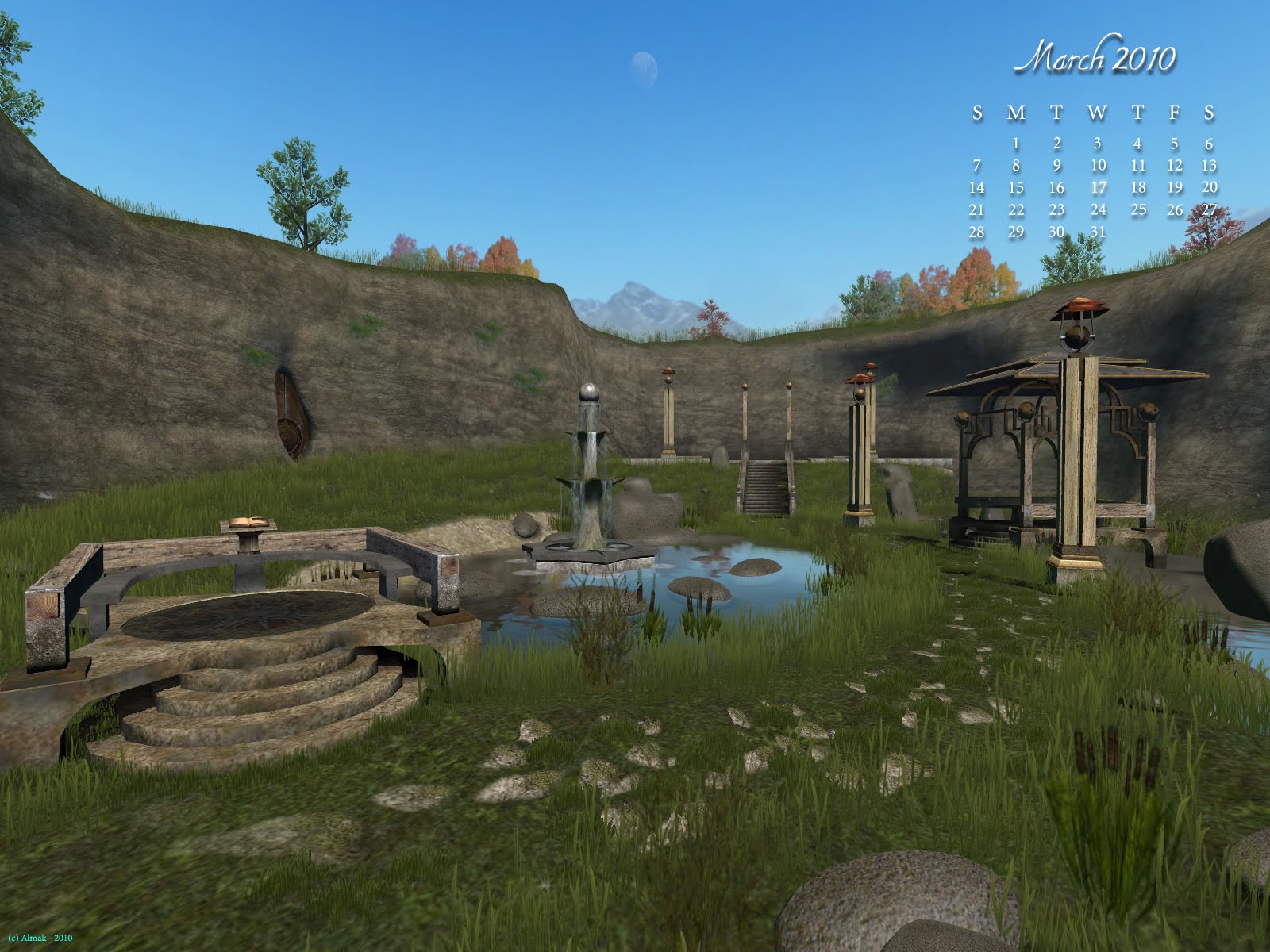
In-game shot of Eder Tsogal, one of many worlds from Uru
I’m torn between describing the history of the Myst/Uru franchise and why this is important, and describing the in-character historical backdrop against which Uru plays out.
In brief, this is the second time Uru has returned, and may be the first time any MMO has gone open-source. Prior knowledge of the Myst series is useful, but not necessary. You just have to like puzzles.
Uru takes place on Earth in the present. “Uru” has its origins in the Sumerian, and connotes “deep city.” There’s a happy coincidence that the name spells out “you are you,” as many people make avatars representative of themselves. There are no orcs or elves here.
Not long ago, a group of explorers uncovered the remains of an ancient civilization in an immense cave beneath the New Mexico desert. The city – and its civilization – were called the D’ni. The main characters of the other Myst series were the last remnants of this civilization. The explorers wanted to restore the city and founded the “D’ni Restoration Council.” Many individuals (the players) felt a “calling” to join them, and thus find themselves in the New Mexico desert. But Yeesha, last of the D’ni, may not be dead, and may have different goals in mind for the restoration.
Anything else would be spoiling things. You’ll do best to find out for yourself. If you have any questions, please feel free to ask.
If you want an invite code, which will put you in the same Neighbourhood as me so we can find each other faster, I’ll be happy to help out.
]]>